14 AUGUST 2026
When Five Loaves Are Enough
What is surrendered to Jesus is never wasted.

By Shikha, S.C.M.A. Communications Director
Scripture: John 6:1-15
There is something deeply human about the disciples' response to the hungry crowd. Jesus looked at thousands of people and said: "Where are we to buy bread, so that these people may eat?"
And Philip looked at the problem. The crowd was enormous. The money was insufficient. The need was immediate. The resources were small. Philip essentially answered, Even if we had enough money, it wouldn't be enough.
And perhaps that is where many of us find ourselves. We know what needs to be done. We can see the need. We can see the people hurting. We can see the dream God has placed in front of us.
But then we look at our hands. And what is in them doesn't seem like enough. Not enough money. Not enough experience. Not enough influence. Not enough courage. Not enough time. Not enough people. Not enough faith.
And so we begin calculating. How can I possibly do this? But Jesus wasn't asking Philip because He didn't know what He was going to do.
John tells us something remarkable: "He said this to test him, for he himself knew what he would do."
Jesus already knew. Before Philip calculated the cost, Jesus knew the answer. Before the disciples found the bread, Jesus knew there would be bread. Before the miracle became visible, it already existed in the mind of God. And perhaps that is something we desperately need to remember.
God is never surprised by the size of the need. We are. Jesus isn't. Then Andrew finds a boy.
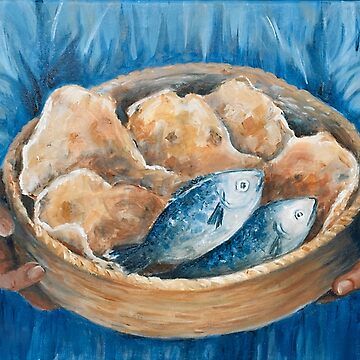
Five barley loaves. Two fish. That's it. It almost sounds ridiculous. Thousands of hungry people. And one child's lunch. Andrew even says: "But what are they for so many?"
There is a strange honesty in that sentence. He found something. But he immediately compared it to the size of the problem. And isn't that what we do?
God puts something in our hands, and instead of asking, "What can Jesus do with this?" we ask, "But what difference could this possibly make?"
We look at our smallness and forget His greatness. We measure the bread instead of looking at the Bread of Life. We count what is missing instead of noticing who is present.
The boy didn't have enough. But he had something. And he gave it. That is where the miracle begins. Not when there was abundance. But when someone surrendered their insufficiency.
Jesus takes the loaves. He gives thanks. And then He breaks them. That detail is easy to rush past. Jesus doesn't make the boy's offering look impressive before using it. He takes what is ordinary. He takes what is small. He takes what seems inadequate.
And He gives thanks for it. Then He breaks it. And somehow, in the hands of Jesus, brokenness becomes distribution. What looked like the end of something became the beginning of provision. Perhaps some of us are afraid of being broken. We think being broken means being unusable.
But this miracle tells us something different. What is surrendered to Jesus is never wasted. Your broken season can still feed someone. Your weakness can still become someone's encouragement. Your limited resources can still become someone's provision. Your ordinary story can still become someone's testimony. You don't have to become extraordinary before God can use you. You simply have to become available.
And then something astonishing happens. The crowd eats. Not barely. Not just enough to survive. They eat as much as they want. And when everyone is satisfied, Jesus tells the disciples to gather what remains. They collect twelve baskets. Twelve.
More than they started with. The miracle wasn't merely that Jesus made enough. He made more than enough. This is the God who doesn't merely meet the need. He reveals that our calculations were never the measure of His ability.
But John takes us even deeper. Because the very next day, Jesus explains what the miracle was really pointing toward. The crowd wanted more bread. Jesus wanted to give them Himself. They had eaten until they were full, but they were still hungry for something deeper.
And Jesus says: "I am the bread of life."
That changes everything. The miracle wasn't ultimately about bread. It was about Jesus. Because you can have your physical hunger satisfied and still have an empty soul. You can have enough money and still feel poor. You can have success and still feel lost.
You can have people around you and still feel profoundly alone. There is a hunger inside humanity that no earthly provision can permanently satisfy. And Jesus doesn't simply say, "I can give you bread."
He says, "I am the bread." He doesn't merely offer something from Himself. He offers Himself. Maybe that's why this miracle matters so much. Because most of us spend our lives asking God to multiply what we have.
Multiply my money. Multiply my opportunities. Multiply my strength. Multiply my relationships. Multiply my work. And sometimes God does.
But perhaps the deeper prayer is: "Jesus, if all I have is five loaves and two fish, let it be enough because You are in it." The miracle isn't always God giving you more. Sometimes the miracle is realizing that Jesus Himself is enough.
So what is in your hands today? Maybe it feels embarrassingly small. Give it to Him. Your five loaves may not feed five thousand in your hands. But you were never asked to perform the miracle. You were asked to surrender the lunch. Jesus does the multiplying.
You bring what you have. He decides what it can become. And perhaps one day you'll look back and realize: "I thought I didn't have enough."
But Jesus was there all along. And somehow, He made a way out of what I thought was too little.
A Prayer For The Heart:
“Jesus, I bring You what I have. Not what I wish I had. Not what I think I should have. Not what everyone else seems to have. Just what is actually in my hands. My five loaves. My two fish. My limited strength. My imperfect faith. My ordinary life. Take it. Break it. Multiply it. And teach me not to measure my offering by the size of the need, but by the greatness of the One receiving it. When I look at what I lack, remind me that You are enough. When I am afraid that I cannot do what You have called me to do, remind me that You never asked me to be the miracle. You only asked me to place what I have in Your hands.”
Amen.